Remember the beginning? AI arrived at companies from the top down. The email from the C-level said everybody had to use it, for everything, now. There was a goal for usage, but no goal for results. No limit, no budget, no questions. In Brazil we have a name for this style of management. XGH, eXtreme Go Horse. First you do it, then you think, and if something breaks you do it again, faster .
I saw everything
In these two years I saw everything in this industry. Whole “projects” born from a single prompt, with a beautiful slide and zero users. And my favorite one. A Tetris clone, much worse than the original of course, presented with pride as proof that this was what the company needed. Nobody could explain which customer was waiting for a Tetris.
A lot of tokens burned for very little result. And when nobody looks at the bill, the bill grows in silence.
The bill arrived
Now the numbers are showing up. According to TechCrunch, Uber burned through its entire 2026 AI coding budget by April, and Microsoft revoked its developers’ Claude Code licenses a few months after rolling them out. In October, a Cloudera survey of 1,500 IT leaders showed that 89 percent have already limited or redesigned AI use cases because of token consumption, and 45 percent moved workloads because of high or unpredictable costs. Retool asked 101 tech leaders, and 43 percent said they are spending more on AI than they budgeted for the year.
And last week, according to Bloomberg, as reported by 9to5Mac, Apple lowered the daily AI limit for some engineers from 300 to 200 dollars, and plans to go down to 100. The funniest detail. Few people were using the full 300.
Engineers with a daily AI allowance. Like teenagers, only with more zeros.
The honest part
Every source has some bias. Cloudera sells a data and AI platform, Retool sells internal tools, and the Apple story comes from anonymous sources. What I bring here is my own perception. First came the order to use everything. Now comes the spreadsheet asking who spent so much. The story is always the same, only the company logo changes.
What I thought from the beginning
I am not a prophet. I just paid a cloud bill before. In 2024 I wrote that code runs on money, and this is the same movie. Free credits, use as much as you want, and one day finance walks into the room.
From the beginning I thought that forcing AI usage, without it being a real tool to reduce cost, would not lead to replacing anyone, in any area. For me the path was always AI and the professional together. Because sooner or later the cost would catch up. And when the cost catches up, the question changes from “how much did you use?” to “what did it deliver?”. The one who answers that question is a person who understands the problem, not the prompt.
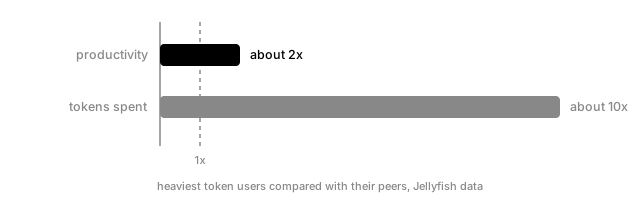
The same TechCrunch article brings a Jellyfish number that sums it all up. The engineers who used the most tokens were about twice as productive, but they spent ten times more tokens to get there.
AI did not replace the professional. It became a bill that needs a professional to be worth it.
The business side, because there is always one
The price per token goes down, but the bill goes up, because agents run in loops and nobody measures what comes out on the other side. I talked about this in More Code, Not More Software. Measuring usage was the mistake. The allowance is the brute force fix.
The good fix is boring, as always. Know the cost per delivered result, not per token. Give the tool to people who know what to do with it, on the problem that pays back. And accept that for some tasks the right answer is not to use AI. That is not being old fashioned. It is management.
A good tool in the hands of someone who understands the problem pays for itself. In the hands of go horse, it becomes Tetris.
Pax et bonum.