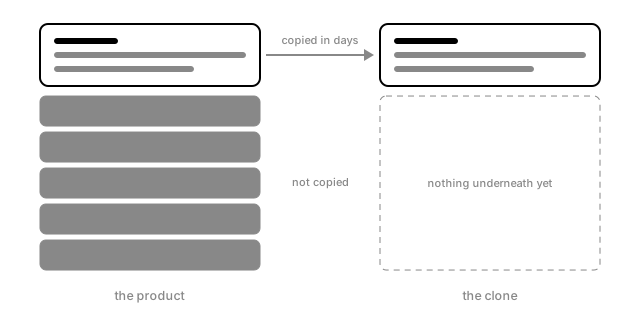
Every company has that slide. “Our differentiator.” Usually it comes with a nice screenshot of the main screen of the product. In the first two weeks of October, a few developers showed that for many companies, that slide fits in a few days of agent work.
What happened
A tool called REA, short for Reverse Engineer Anything, connects coding agents like Claude Code and Codex to professional reverse engineering tools. One of them is Ghidra, the suite the NSA released to the public in 2019. According to Decrypt, the project went from fewer than 10,000 GitHub stars on October 6 to more than 100,000 on October 12. More than 30,000 of those came in a single day.
In the same wave, but without REA, developer Brandon Thomas used Claude Opus 5.5 to build ArtCraft, a set of free apps written in Rust that mirror Photoshop, Illustrator, Premiere and friends. He calls it a clean room rebuild. The code is written from scratch, only by watching how the original behaves. According to innFactory, the first PhotoCraft commit is from September 30. By October 7 there were clones of Word, Excel and PowerPoint too. And Thomas told Ars Technica that “software is over”.
The internet did what the internet does. Half of it screamed “the end of software”. The other half screamed “piracy”.
The part the headlines skipped
The numbers that came right after did not make the headlines. According to innFactory, on October 5 the PhotoCraft roadmap itself estimated its readiness for professional use at 25 to 35 percent. WordCraft talked about 60 percent of the way to replacing Word. A pixel artist told Decrypt the Photoshop clone was “completely unusable”. And Thomas changed his promise of matching Adobe in one month to “months”.
There is one detail I love. PhotoCraft can save back, byte for byte, 134 of 135 real test files. It looks almost done. But that one missing file is exactly where the product lives. The rare case, the file from 2009, the customer who does everything in the way nobody expected.
Anyone who has worked on real software knows the old rule. The first 90 percent of the work takes 90 percent of the time. The other 10 percent takes the other 90 percent .
And the usual warning. Every source has some bias. innFactory is a consultancy that sells AI work, Decrypt covers hype with pleasure, and Thomas has a project to promote. What I bring here is my own perception, from talking with engineer friends about the companies where they work, at meetups, over coffee, in late night messages. When the conversation gets to the system that pays the bills, nobody talks about the screen. Everybody talks about the migration that went wrong, the big customer with a special rule, the integration nobody documented. The story is always the same, only the company logo changes.
The business side, because there is always one
innFactory said it well. Features alone are no longer a moat. I agree, and I think they never were.
Think about the person who buys Word for a bank. This person is not buying the toolbar. They are buying the promise that when it breaks, someone answers the phone. They are buying compliance, audits, a contract, support, compatibility with twenty years of documents, and integration with everything else in the house. None of this shows up in a screenshot. Cloning the screen got cheap. Cloning the trust is still expensive.
What really changed is the cost of copying the visible part. That is a serious problem for anyone who only had the visible part. For companies with data, operations, relationships and years of edge cases already solved, it is just one more noisy competitor. Cloning the look of Photoshop took a few days. Maintaining it will take the rest of their lives.
There is also the legal side, and here I am not a lawyer. According to innFactory, in Europe observing how a product works is usually allowed, and copying its code is not. REA’s own disclaimer says the project will not help anyone bypass DRM or copy proprietary software. The tool is neutral. What people do with it is not.
And for us, engineers
In April I wrote about what did not change, and this story is the same argument in new clothes. If the screen got cheap, our value is in the boring part. The edge case, the migration with zero downtime, the system that runs at three in the morning and nobody notices. Like I said in The Typing Got Free, the Deadline Did Not, typing became free. Understanding the problem did not.
Software did not end. What ended is the illusion that the screen was the product.
Pax et bonum.