There is a sentence I hear in every AI conversation this year. “We have a pilot running.” Everybody has a pilot running. The pilot has a nice demo, a nice slide, a friendly internal name. What almost nobody has is the second sentence. “It is in production, serving real customers, solving real business problems, optimizing processes, raising efficiency, and so on.”
The numbers arrived and they are embarrassing. MIT measured in 2025 that 95 percent of corporate GenAI pilots delivered no measurable return. Gartner predicts that more than 40 percent of agentic AI projects will be canceled by the end of 2027, because of growing costs, unclear business value, or weak risk controls. Meanwhile, at the individual level, adoption exploded. A Temporal survey of more than 550 engineers shows 80.8 percent using agents daily, up from 47.3 percent a year before. Look at the contrast. People already live with agents every day. Companies cannot get them off the stage.
Gartner even gave a name to part of the problem. “Agent washing”, vendors rebranding an old chatbot or an RPA script as an “agent” to ride the wave. By their estimate, of the thousands of agent vendors in the market, only around 130 are real. So a part of the pilots out there is not even a pilot of an agent .
But let me be honest about one thing. Every source has some bias. Marketing bias, commercial interest, or just the way the question was asked. So do not hold too tight to the exact numbers. What I bring here is my own perception, from talking with engineer friends about the companies where they work, at meetups, over coffee, in late night messages. The story is always the same, only the company logo changes. And I am almost sure you have heard this story too, or you are living it right now.
The gap has a name, and it is not technology
What separates the pilot from production is not the model. The models are great. What separates them is the boring part I wrote about in the comprehension debt note: error handling, security, observability, permissions, audit trails. The demo needs none of that. Production is made of almost nothing else.
A pilot answers the question “does this work?”. Production answers a much more expensive question. Who answers when this fails at two in the morning? Most pilots were never designed to answer the second question, and that is why they never go up. It is not lack of capability. Going up costs real engineering, and real engineering does not fit in the budget of an experiment.
And there is a detail I already wrote in that same note, and I repeat here with care. A self-taught business person, with or without ChatGPT on the side, helps a lot, and I applaud every one of them. But when the system grows, at some point the problem gets bigger than the prompt, and somebody needs to explain why the thing holds the load, or why it does not. This is not gatekeeping. It is the same reason I do my taxes in an app, but a big company has an accountant.
Why the pilot never dies
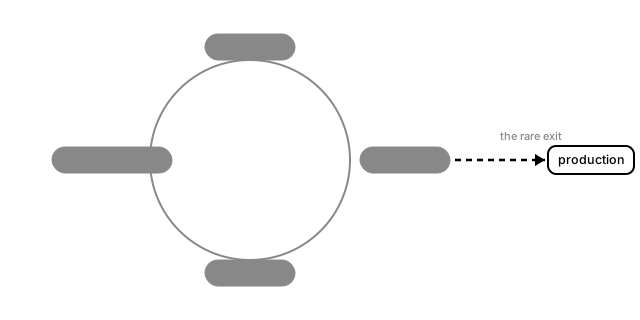
There is an incentive side nobody says out loud. The eternal pilot is comfortable for everybody. The team likes it, because it is the fun project. The executive likes it, because it shows up in the innovation report. Nobody kills their own pilot, and nobody takes the risk of putting it in production. The deadline that was yesterday becomes next month, next month becomes next quarter, and the pilot keeps getting pushed along. The pilot has all the benefits of innovation, minus the risk of actually working .
But from the business point of view, and you know this is always where I end up, a pilot that never lands is not a pilot. It is an expensive hobby. It costs salaries, it costs tokens, it costs meetings, and it returns slides. The companies that crossed the bridge are buying real advantage while the others pay to watch demos.
The boring path, again
You already know how I end. The path that works is the boring one. One small use case, with clear boundaries and narrow permissions. Metrics before scaling, to know if the agent pays its own cost. Observability from day one, because an agent without an audit trail is an intern without a supervisor and with access to the database. And only after that, the second use case.
Production is where software earns a salary. A pilot is where it earns a stage. I keep choosing to pay salaries.
Pax et bonum.