There is a new kind of pull request in the industry, and everybody I talk to has already met it. The agent opens it a few minutes after someone describes the task. Hundreds of lines, tests green, description polite and well formatted. I keep hearing the same story in meetups here in Calgary and in conversations with engineers from very different companies. The agent is fast, the code is often good, and the humans feel like the slowest thing in the room. But somebody still has to read that code, understand it, and answer for it later. That somebody is always a person with a salary and a pager.
Before you call me an AI denier, one thing. If you read my other notes you will see I always try to look at both sides of the coin. Agents earn their keep in my daily work, and I have written about the good side many times. But every hype wave deserves a look at the shadow too, and this note is mostly about the shadow. Do not get stuck on that. These are my thoughts at this moment, not a lesson, and I am not trying to prove I am right. I am just thinking out loud.
Four years ago I opened this blog with a note saying that code review is not about ego, it is about money. The expensive part of a pull request was never the typing. It was the human attention around it. I had no idea how big that bill was about to become.
The numbers arrived
For a while this was only a feeling in my chest during reviews. Now the industry data is here, and it is not subtle.
The Cortex 2026 benchmark report measured what happened to engineering teams in the agent era. Pull requests per author went up 20 percent. Incidents per pull request went up 23.5 percent. We are shipping more, and each pull request breaks more than it used to. The Faros AI report found something worse. When teams move from low AI adoption to high AI adoption, the ratio of incidents to pull requests grows 242.7 percent. The faster the pipe, the dirtier the water.
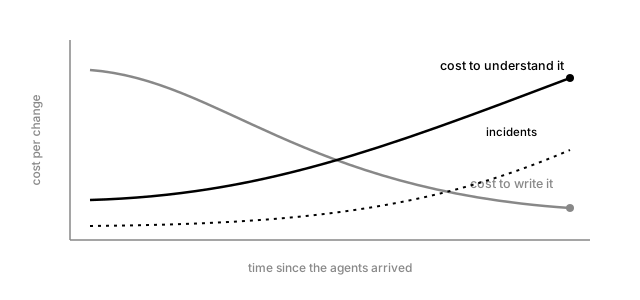
My favorite study is the METR experiment, because it measured the gap between feeling and fact. Experienced developers predicted AI would make them 24 percent faster. Measured properly, they were 19 percent slower. And in the follow up review, zero percent of the AI pull requests were mergeable as they arrived. Zero. We are optimists with commit access . The agent types fast, so the work feels fast. Feelings are not invoices.
Back in 2024 I wrote about the GitClear report that first showed AI code churning more than human code. The same GitClear came back with a 211 million line study. Copy and paste code grew from 8.3 to 12.3 percent of all changes. Refactoring fell from around 22 percent to 10. We are pasting more and tidying less. Every developer with gray hairs knows how that movie ends, because we spent our careers cleaning the theater.
The debt got a name
Addy Osmani gave the pain a vocabulary this year. First the 80 percent problem, the observation that agents produce the visible 80 percent of a feature and quietly skip the 20 percent that decides if it survives production. Then the sharper term, comprehension debt.
Classic technical debt is a loan you choose. You know the code is ugly, you know why, you know where. Comprehension debt is different. The code works and nobody fully understands it. Not the agent, which forgot the conversation the moment it ended. Not the developer, who read it the way we all read terms and conditions. The interest is not charged monthly. It is charged all at once, at two in the morning, during an incident, when the person on call opens a file that no human mind has ever truly visited.
I have inherited legacy systems written by people who left the company. Now we generate legacy code in real time, and the author leaves the company the moment the context window closes.
Cavallini, Thiago
Everybody ships now
More than ever, people everywhere are generating code with AI. People from every area, every title. And let me be clear, I am not saying they are not capable, and you do not need an IT diploma to build things. The tools are that good, and honestly, welcome to the club. More people solving their own problems is a good thing.
But there is one fact that no prompt can fix. Engineering fundamentals do not come in the box with the AI subscription. They come from study and from scars. You can get angry at this sentence, it stays true anyway. The thing will build. It will run. It will demo beautifully. Then one day it needs to scale, and it fails exactly on the fundamentals, and that can kill the whole project.
For an internal tool or a personal project, fine, it will probably work. I am talking about the other kind of project. Scale, security, millions of users hanging on it. In that world the debt gets personal. Over time, you can end up understanding less and less of your own codebase. A strange kind of ownership, paying the mortgage on a house where you do not know what is behind the walls.
Reading became the job
Here is what I keep observing, in my own work and in every one of those conversations. The job did not disappear. It moved. I describe problems, I question the approach, I read the diff like it came from a very fast stranger, and I check the boundaries against the rest of the system. The typing got cheap. The understanding did not get cheaper, it just became the whole job.
This is a business problem wearing a technical costume, which is my favorite kind. A company that measures agent output by volume is measuring the size of the loan and calling it revenue. The teams in those reports that got faster and safer at the same time are the ones that spent the saved typing time on reading, on specs, and on tests they actually understand.
Which brings me to the ending you already expect from me. The answer is boring. Small pull requests, reviewed with attention. Specs written before the prompt. Tests that a human can explain. It was boring in 2022 when I wrote about review and ego, and it is boring now with agents in every editor. I work at a company whose whole investment philosophy is that boring wins over time. Software keeps proving the same thing. The debt collectors always show up eventually. Better to owe them nothing but attention. As for me, I plan to keep being the boring one in this story .
And do not say later that I did not warn you. Everywhere I look these days there is an MVP that skipped review, because hey, it is just an MVP, quietly becoming production. At this point, God’s will be done!
Pax et bonum.