If you opened any tech conference agenda in the last year, you saw it. Platform engineering is the new term everywhere. Gartner put it on their hype lists, vendors renamed their products overnight, and suddenly every company needs an internal developer platform. When the marketing gets this loud, my years of scars tell me to slow down and ask the boring question. Is this a real change or a new sticker on an old box?
My honest answer is both, and the difference between the two is worth a lot of money.
Let me describe the real problem first, because the problem is very real. In a company with many product teams, every team needs the same plumbing. Pipelines, environments, secrets, monitoring, deployment, security scanning. Without a platform, each team builds its own version of this plumbing. I have watched this from inside, and the waste is impressive. Five teams maintaining five slightly different deployment setups means five times the maintenance, five sets of weird edge cases, and a new developer who has to relearn everything when they switch teams.
Now multiply by salaries. If each team spends fifteen percent of its time on plumbing, across ten teams that is more than one full team worth of capacity going to duplicated infrastructure work. A good internal platform collapses that duplication into one place. New service goes from two weeks of setup to one afternoon. New developer onboards in days instead of weeks. Those are not opinions, those are numbers a CFO can read. Onboarding time and ops cost are real line items.
Where it goes wrong
So the promise is solid. Why am I careful? Because I have also seen the failure mode, and the failure mode is expensive.
It goes like this. The company creates a platform team. The platform team is staffed with strong infrastructure people, which is good. But nobody gives them a product mindset, which is fatal. They build the platform they find technically interesting, with the tools they wanted to learn. They announce it is mandatory. Product teams now have to file tickets and wait for another team to do what they used to do themselves in an hour.
Congratulations, you did not build a platform. You rebuilt the old ops silo and gave it a modern name. The exact silo that the DevOps movement spent a decade tearing down. Tickets, queues, waiting, two groups blaming each other. The new name changed nothing because the operating model is the same.
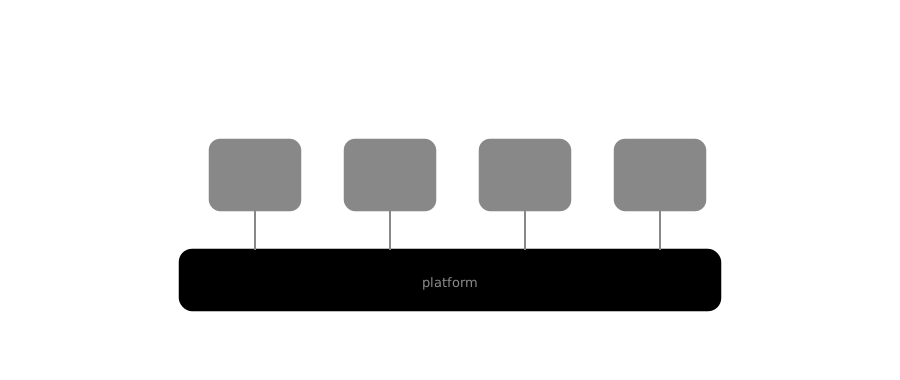
This is why I say the name does not matter and the model does. The book Team Topologies, by Matthew Skelton and Manuel Pais, gave us the right frame before the hype arrived. A platform is a product, and the developers are its customers. Not users by decree. Customers, with the option to be unhappy.
The product test
When someone shows me their internal platform, I run a simple test, the same test I would run on any product. It comes from my agency years in Brazil, where a product nobody wanted to pay for was dead no matter how clever it was.
Is it optional? The strongest signal of platform quality is teams choosing it because it is genuinely the easiest path, what Team Topologies calls the thinnest viable platform with voluntary adoption. If you need a mandate to get usage, the product is not good enough yet, and the mandate is hiding that signal from you.
Does the platform team talk to its users? Real product teams do interviews, measure adoption, track time to first deploy, and cut features nobody uses. A platform team should have a roadmap shaped by developer pain, not by the infrastructure team’s curiosity.
Does it reduce cognitive load or relocate it? The whole point is that product developers think less about plumbing and more about customers. If developers now need to understand the platform’s abstractions plus the things underneath them, because the abstractions leak, you added load instead of removing it.
Is there a number? Onboarding days, deploys per week, time from commit to production, on call incidents from infrastructure. Pick a few and watch them. A platform that cannot show movement on any number is a cost center asking for faith.
So, name or change?
Here is my conclusion. Platform engineering as a fashion is just a name, and the wave of rebranded ops teams will mostly fail quietly and expensively. Platform engineering as a practice, an internal product with real customers, voluntary adoption, and measured outcomes, is a real change and one of the best investments a growing engineering org can make.
The technology is honestly the easy part. The hard part is the discipline to treat your own developers as customers who can walk away. Get that part right and the platform pays for itself in onboarding time, ops cost, and fewer 3am pages. Get it wrong and you bought a very modern silo. The name on the door will not save you either way.
Pax et bonum.